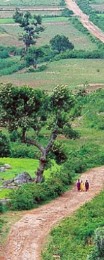
Vizag, the Port city is the jewel on the eastern coast of
India, 2nd Biggest City Next to Capital Hyderabad. The City is a harmonious
blend of the magical past and the bustling present with a breath taking
panorama of golden beaches, lush green fields, verdant valleys and splendid
monuments from a historically rich and religious heritage.
Matchless in beauty and landscape, Vizag is said to have derived its name from
the deity 'Visaka' ( the God of Valour) the son of Shiva and Parvati, who is
also the ruler of the planet Mars and the God of war. Legend says that an
Andhra king (9-11th century) on his way to Benares rested here. So enchanted
was he with the sheer beauty of the place that he ordered a temple to be built
in honour of his family deity, Visakha. Archaeological sources, however,
reveal that the temple was possibly built between the 11th and 12th centuries
by the Chola king, Kulottunga Chola I. A shipping merchant, Sankarayya Chetty,
built one of the mandapams, or pillared halls, of the temple. Although it no
longer exists (it may have been washed away about a hundred years ago by a
cyclonic storm), elderly residents of Vizag talk of visits to the ancient
shrine by their grandparents.
The Epic City. The antiquity of the region is evident as it is mentioned in
both the Ramayana and Mahabharata. The former tells of the forests through
which Rama travelled in search of his abducted wife Sita , and where he meets
his devotee, Shabari, who directs him to the mountains where Hanuman lives.
Rama also meets Jambuvan, half-bear half-man, who helps him in his battle with
Ravana. It was here, too, that Bheema defeated the demon Bakasura - the
Pandava's huge stone club can be seen in the village of Uppada, about 40 km
away.
Buddhist Influence. The religious Hindu texts mention that the region of Vizag
in the 5th century BC was part of the vast Kalinga territory which extended up
to River Godavari. The relics found in the area also prove the existence of a
Buddhist empire in the region. Kalinga later lost the territory to King Ashoka
in the bloodiest battle of the time which prompted him to embrace Buddhism.
Business Center. The territory of Vizag then came under the Andhra Rulers of
Vengi. Then Chankyas, Pallavas, the Reddy Kings ruled over the placid land.
The Chola Kings built the temples in the city in 11-12 century AD as
established by Archeological findings. The Mughals ruled this area under the
Hyderabad Nizam in the late 15th and early 16th century. The merchants from
Europe, the French, the Dutch and the East India Company used this natural
port to export tobacco, ivory, muslin and other textile products.
Once a Small fishing Village under the Mighty Kalinga Empire during the regime
of Ashoka the Great (272-232 B.C). Later on this Port town successively passed
on from the Andhra Kings of Vengi to the Pallavas, Cholas and the Gangas and
then later in the 15th century Vizag became a part of the Vijaya Nagar Empire.
In the 18th century, Vizag was part of the Northern Circars, a region of
Coastal Andhra that came first under French control and later that of the
British. During British Vizag became a district in the Madras Presidency of
British India. The British took charge of this beautiful land and transformed
it into a busy and flourishing Port town.